

What is Amharic?
Amharic, called አማርኛ in Amharic, belongs to the Semitic language family, together with Arabic and Hebrew.
Its development was also influenced by contact with other Ethiopian languages. For example, while many Semitic languages often place the verb near the beginning of the sentence, in Amharic the verb normally comes at the end:
subject + object + verb
This feature makes Amharic familiar in some ways and surprising in others.
Why is Amharic a Semitic language?
Amharic belongs to the Semitic language family, alongside modern languages such as:
- Arabic;
- Hebrew;
- Modern Aramaic;
- Tigrinya;
- Tigre;
- Maltese.
Ancient languages such as Akkadian, Phoenician and Geʿez also belong to this family. Geʿez is no longer spoken as a native language, but it is still used in Ethiopian religious and liturgical traditions.
These languages are considered “relatives” because they developed from a common linguistic ancestor and share several characteristics. One of the most interesting is the use of roots formed mainly from consonants.
In Amharic, for example, several words connected with studying and learning come from the same root:
- ተማረ – tämarä: he studied;
- ተማሪ – tämari: student;
- ትምህርት – tïmhïrt: lesson, education;
- አስተማሪ – astämari: teacher.
The main consonants preserve the basic idea, while vowels and other elements modify the meaning. It is as if every word belonged to the same family and carried a recognisable part of its linguistic DNA.
But why are they called “Semitic” languages?
The name does not come from an Amharic, Arabic or Hebrew word. It was introduced into European linguistics in 1781 by the scholar August Ludwig Schlözer.
Schlözer was inspired by Shem, one of Noah’s sons in the biblical account, because several peoples of the Near East were traditionally associated with his descendants in biblical genealogies.
Today, however, “Semitic” is primarily a linguistic term. It identifies a family of historically related languages. It does not mean that everyone who speaks these languages belongs to one people, follows the same religion or shares the same culture.
Amharic therefore reminds us that the Semitic language family does not belong only to the Middle East: an important part of its history also developed in the Horn of Africa.
An alphabet that is not exactly an alphabet
The Ethiopic writing system is called ፊደል – fidäl.
In everyday language, we can call it the “Ethiopic alphabet”, but more precisely it is an alphasyllabary, or abugida: each character generally represents a consonant accompanied by a vowel.
Let us look at this family:
ሀ ሁ ሂ ሃ ሄ ህ ሆ
hä – hu – hi – ha – he – hï/h – ho
We do not add a separate vowel to the letter. The character itself changes shape.
These seven transformations are called “orders” and generally correspond to:
ä – u – i – a – e – ï or no vowel – o
The system is not completely regular, so some forms must be memorised. This is also what makes the fidäl suitable for visual learning: we can look for legs, loops, strokes and similarities among its characters.
“Hello” does not always mean only “hello”
We can greet someone by saying:
ሰላም – sälam
Peace; hello.
In everyday conversation, however, people often ask directly whether the other person is well:
ደኅና ነህ? – dähna näh?
Are you well? — addressed to a man.
ደኅና ነሽ? – dähna näsh?
Are you well? — addressed to a woman.
ደኅና ነዎት? – dähna näwot?
Are you well? — respectful form.
We can answer:
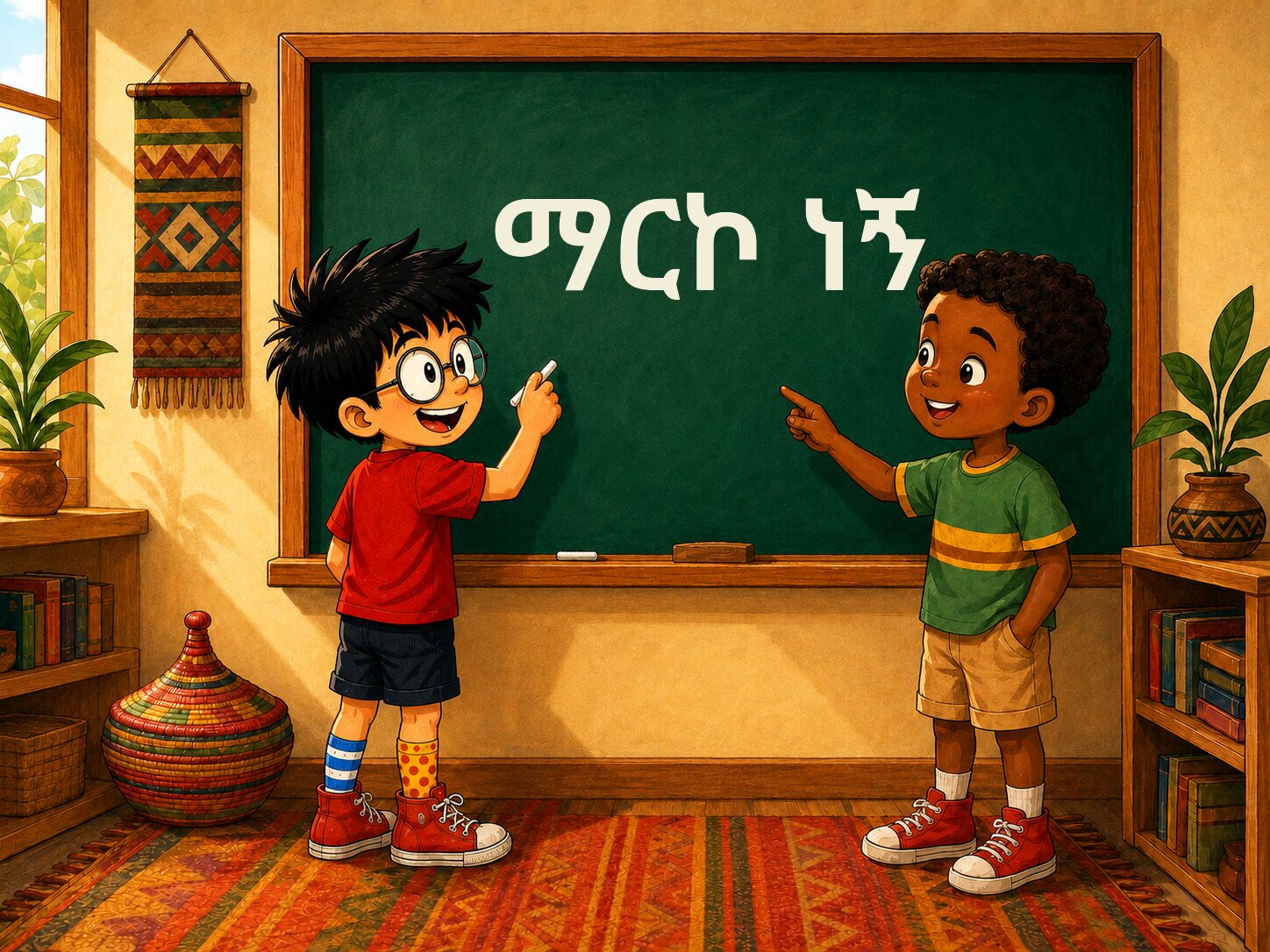
ደኅና ነኝ – dähna näñ
I am well.
The greeting may be followed by questions about family members and loved ones. Greeting someone, therefore, is not just about saying a word: it means showing genuine interest in the other person.
Useful expressions
| Amharic | Transliteration | Meaning |
|---|---|---|
| ሰላም | sälam | Peace; hello |
| እሺ | ïshi | All right; okay |
| አዎ | awo | Yes |
| አይደለም | aydälläm | No; that is not so |
| አመሰግናለሁ | amäsäggïnallähu | Thank you |
| ይቅርታ | yïk’ïrta | Excuse me; I am sorry |
| አልገባኝም | algäbaññim | I did not understand |
| ምን ማለት ነው? | mïn malät näw? | What does it mean? |
The last two expressions are particularly useful for language learners:
አልገባኝም!
I did not understand!
ምን ማለት ነው?
What does it mean?
We do not need to know hundreds of words before we start communicating. Sometimes it is enough to know how to greet someone, say thank you and ask for an explanation.
A language to observe
The fidäl teaches us something important: not all writing systems organise sounds in the same way.
When learning Amharic, we should not only read. We should observe:
- which part of the character changes;
- which vowel it represents;
- which characters belong to the same family;
- which forms are exceptions.
It is almost like a meeting between language, memory and drawing.
The unexpected side of Amharic: walking eggs and almost-emojis
A language is not made up of grammar alone. It also contains images, jokes, sayings and small details that tell us something about the culture of its speakers.
Amharic offers some truly surprising examples.
Little by little, even the egg begins to walk
Amharic has this amusing proverb:
ቀስ በቀስ እንቁላል በእግሩ ይሄዳል።
K’es be-k’es, inqulal be-igru yihedal.
Its literal translation is:
“Little by little, even the egg walks on its own legs.”
But how can an egg walk?
Of course, it must first hatch and become a chick. The proverb teaches us that, by progressing little by little, we can achieve results that initially seem impossible.
It is a perfect expression for language learners:
- today we learn one letter;
- tomorrow we recognise a word;
- the day after tomorrow we use it in a conversation.
When Marco sees all the Amharic characters, he might say:
“I will never be able to learn them all!”
The egg could answer:
“K’es be-k’es, Marco! Look at me: I could not move before, but now I can walk!”
The inverted exclamation mark: an ancestor of emojis?
How can we tell, when reading a message, whether someone is being serious or sarcastic?
Today we add a face, an emoji or perhaps write: “I’m joking!” In the Amharic writing tradition, however, there is a very unusual mark:
¡
It looks like an inverted exclamation mark and is called temherte slaq — ትእምርተ፡ሥላቅ.
It was placed at the end of a sentence to indicate that the words should be interpreted ironically or sarcastically. When readers saw the symbol, they understood that the intended meaning could be the opposite of the literal one.
Imagine Marco’s mother entering his room and finding books, sheets of paper and pencils scattered everywhere. She might say:
“As usual, Marco has left his desk perfectly tidy¡”
The inverted exclamation mark tells us that his mother is not really complimenting him. She means exactly the opposite: the desk is a complete mess!
From this perspective, the temherte slaq could jokingly be described as a functional ancestor of emojis. It did not give rise to modern smiley faces, but it served a similar purpose: it helped readers understand the emotional tone of a sentence.
There is one important difference: the mark is not common in contemporary Amharic. It may occasionally be found in particular texts or in satirical and political cartoons. Modern Amharic normally uses the ordinary exclamation mark !
We should also avoid confusing it with Spanish punctuation. In Spanish, ¡ is placed at the beginning of an exclamatory sentence. In the Amharic tradition, the temherte slaq was placed at the end to indicate sarcasm.
Perhaps emojis did not invent something entirely new. Long before smartphones, people had already understood that writing communicates not only words, but also the tone in which we imagine them being spoken.
The Cassano Academy challenge
Try copying these characters slowly:
ሀ ሁ ሂ ሃ ሄ ህ ሆ
Then choose three expressions:
ሰላም – እሺ – አመሰግናለሁ
Do not worry if your characters are not perfect at first. A new language often begins with an uncertain mark, a funny pronunciation and plenty of curiosity.
እሺ? All right? Let’s begin!
FAQ
No. Although Amharic belongs to the Semitic language family, it is written from left to right, like Italian and English. It uses the Ethiopic writing system known as ፊደል — fidäl.
Amharic is called Semitic because it belongs to the same historical language family as Arabic, Hebrew, Aramaic, Tigrinya, Tigre and Maltese. These languages developed from a common linguistic ancestor and share features such as word formation based mainly on consonantal roots. “Semitic” is a linguistic term: it does not identify a single people, religion or culture.
At first, the fidäl may look complicated because every consonant changes shape according to its accompanying vowel. However, its characters are organised into families. By learning one family at a time and observing how each form changes, the system gradually becomes more logical and recognisable. As the Amharic proverb says: ቀስ በቀስ — K’es be-k’es — little by little.