


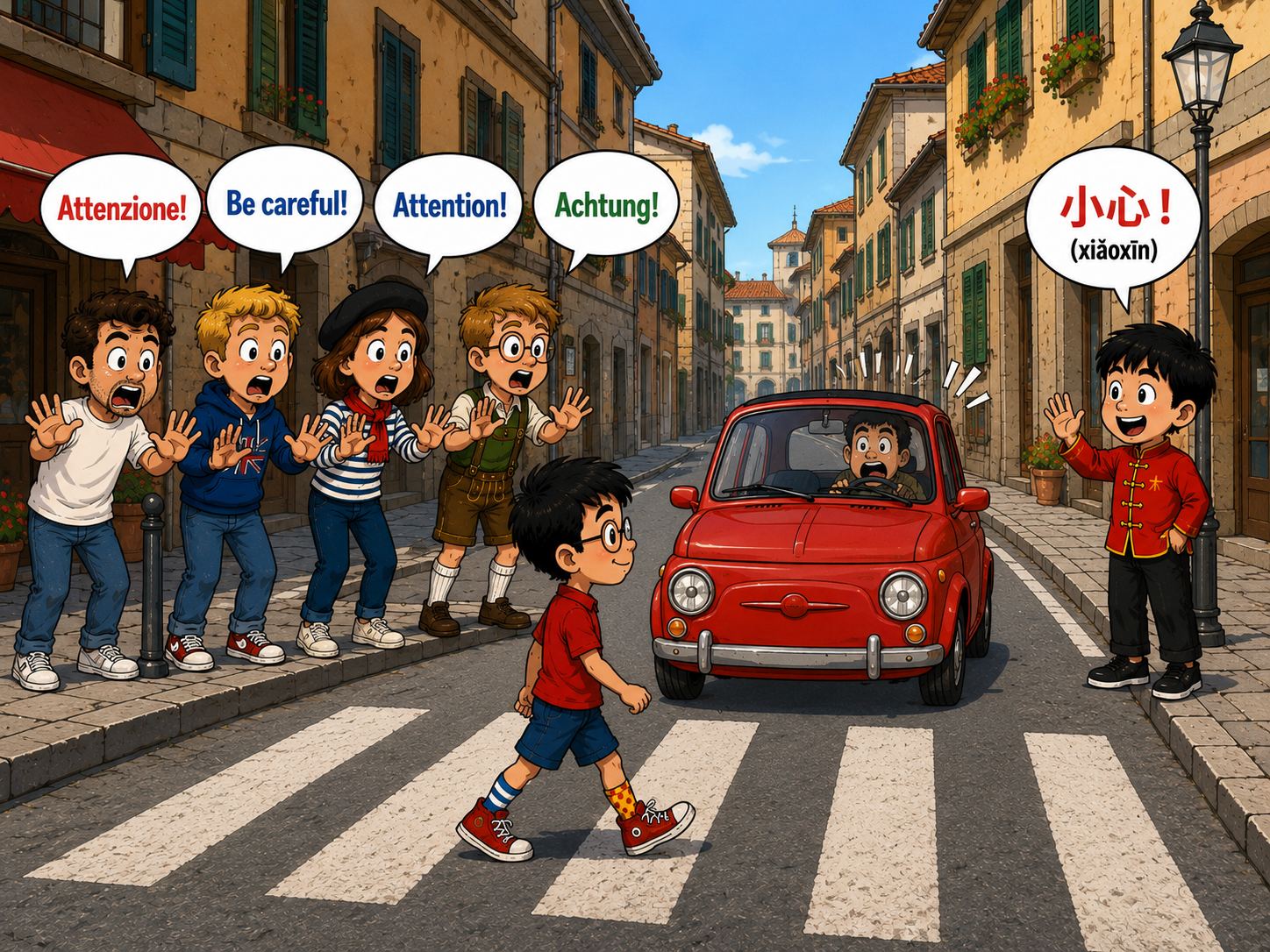
Attention! Why does Chinese say "Small Heart"?
If you are learning a foreign language, sooner or later someone will say:
Attention!
In English, people usually say:
Be careful!
or
Watch out!
In French:
Attention !
In German:
Achtung!
In Italian:
Attenzione!
Do you notice something?
These words are very similar. They all express the idea of paying attention or being careful.
Then you learn Chinese...
...and everything changes.
小心: Two characters, a different way of thinking
In Chinese, when you want to warn someone, you say:
小心 (xiǎoxīn).
If we translate each character separately, we get:
小 (xiǎo) = small
心 (xīn) = heart (and also mind)
So the literal meaning is:
"small heart."
Sounds strange, doesn't it?
Of course, Chinese people are not thinking about a small heart when they use this word.
Today, 小心 simply means:
- Be careful.
- Watch out.
- Be cautious.
- Take care.
It is a very common expression in everyday life.
Why "Small Heart"?
Now comes the interesting part.
In Chinese culture, the character 心 does not only mean the heart.
It can also mean:
- the mind;
- thoughts;
- feelings;
- attention.
So having a "small heart" does not mean being weak.
It means having a careful, calm, and focused mind.
It is like saying:
"Pay attention to what you are doing."
or
"Don't be careless."
It is a very different image from ours, but it is beautiful.
How do different languages say it?
Let's look at some examples.
🇮🇹 Italian
Attenzione! C'è una macchina!
"Watch out! There's a car!"
🇬🇧 English
Watch out!
or
Be careful!
🇫🇷 French
Attention !
🇩🇪 German
Achtung!
🇨🇳 Chinese
小心!
or
小心地滑!
Literally:
"Small heart! The floor is slippery!"
Meaning:
"Be careful! The floor is slippery."
Words Tell Us About Culture
This is one of the most beautiful things about languages.
Two people may want to say exactly the same thing...
...but they use completely different images.
In many European languages, we think about attention.
In Chinese, people imagine a careful heart.
Neither is right or wrong.
They are simply different ways of seeing the world.
And that is what makes languages so interesting.
What Can Language Learners Learn?
When we learn a language, we often look for the perfect translation.
But sometimes there isn't one.
If we translate 小心 word by word, we get:
small heart.
If we translate its meaning, we get:
be careful.
That is why learning a language is much more than learning new words.
It is learning new ways of thinking.
Every word is a small window into another culture.
A tip for language learners
The next time you find a strange word, don't ask only:
"How do I translate it?"
Instead, ask:
"Why does this language use this image?"
Very often, that is where real learning begins.
You are not only learning a language.
You are learning to see the world through someone else's eyes.
And that is worth much more than any dictionary.
What about you?
Do you know a word that sounds strange when translated literally, but makes perfect sense in its own language?
Send me a WhatsApp message!
I'd love to hear your favorite example.
FAQ
Today, 小心 (xiǎoxīn) means "be careful" or "watch out." Literally, it means "small heart," but the character 心 also means the mind, thoughts, and attention—not only the heart.
No. You can also use it when asking someone to do something carefully, such as driving, walking on a slippery floor, or using a knife.
Because knowing the origin of words helps us remember them better and understand how different cultures think. Learning a word often means learning a new way of seeing the world.