


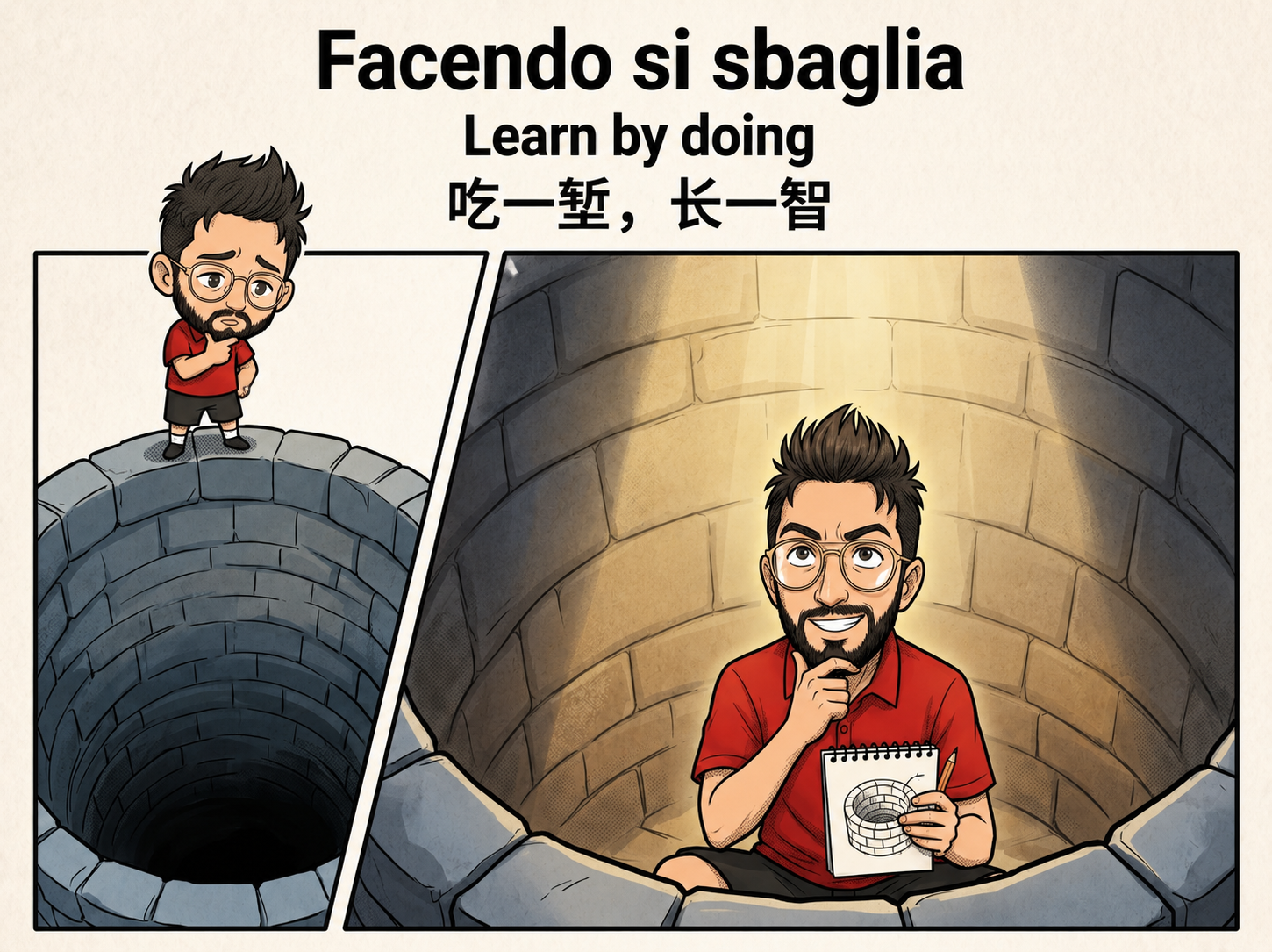
Learn by doing
We all know the old saying: "We learn from our mistakes." It’s a comforting phrase, but in modern language pedagogy and here at Cassano Academy, we like to dig deeper.
Today, I want to introduce another perspective on this concept—a formula I designed by observing the breakthroughs and roadblocks on my personal language learning process:
"By doing, we make mistakes." (Facendo si sbaglia)
It might sound like a wordplay, but it holds a profound pedagogical and neurobiological truth. While it is absolutely true that we learn from our errors, we can only make mistakes if we are actively DOING something. If we stay frozen out of fear, we won’t make mistakes... but we won't learn anything either.
The "Perfect Silence" in language learning
In the neurobiology of language acquisition, there is a massive obstacle known as the affective filter—the fear of exposure and judgment. Many students spend months or years studying grammar books, waiting for the magical moment when they will feel "ready" to speak without errors.
The result? They never speak. They remain trapped in a state of perfect silence.
However, the design of our human brain proves the exact opposite. Language does not develop through mere theoretical accumulation, but through practical activation. The brain needs to process input, but more importantly, it must test output. A mistake is not a failure; it is biological feedback—a signpost telling the brain how to adjust its linguistic structures.
Why doing is the engine of language fluency
If you don't do, you don't make mistakes. And if you don't make mistakes, your brain doesn't receive the data it needs to recalibrate. That is why at Cassano Academy, we flip the traditional approach:
- Action Precedes Perfection: Speaking a new language is a cognitive and neuro-motor skill, just like sports. You don't learn to run a marathon by watching others; you must put on your shoes and take the first steps.
- Mistakes as Badges of Honor: When a student mispronounces a word or confuses a verb tense, I don't see a failure. I see a success! That mistake is tangible proof that the student is active, engaged, and doing.
- Failing Forward: In the English-speaking world, there is a powerful concept: "Fail forward." It means using every mistake as a stepping stone. But remember: you can only fail forward if you are moving forward!
A cross-cultural perspective: Italian, English, and Chinese
This philosophy connects deeply with global wisdom. Let’s look at how different languages map this concept:
- Italian: Sbagliando si impara (By making mistakes, we learn; but only by doing, we make mistakes).
- English: Learn by doing & Fail forward. Mistakes made in action lead you toward your goal.
- Chinese: 吃一堑, 长一智 (Chī yī qiàn, zhǎng yī zhì) – "Fall into a pit, gain in wisdom." You cannot fall into a pit if you stay seated. You must walk towards it!
Start DOING today
The next time you face a conversation in English, Italian, French, German, or Chinese and feel the fear of making a mistake, remember this rule: do not wait for perfection.
Embrace the risk. Leap into action. Remember that by doing, we make mistakes, and it is only through that doing that we truly learn and succeed.
What linguistic "mistake" are you going to make today?
FAQ: Learn by doing
It means that mistakes are not failures, but the natural and positive consequence of taking action. If you don't push yourself to speak or write a new language, you will never make mistakes, which deprives your brain of the essential feedback it needs to correct itself and truly learn.
The secret is to change your environment and mindset. Stop searching for the perfect sentence before opening your mouth. Instead, choose engaging, judgment-free learning environments—like the courses at Cassano Academy—where every mistake is welcomed as a badge of honor and a sign of practical progress.
Absolutely not; grammar is an essential map. However, studying theory without applying it is like reading a car's instruction manual without ever driving the car. Grammar must always be at the service of real conversation.