

Why we aren't born to learn languages alone
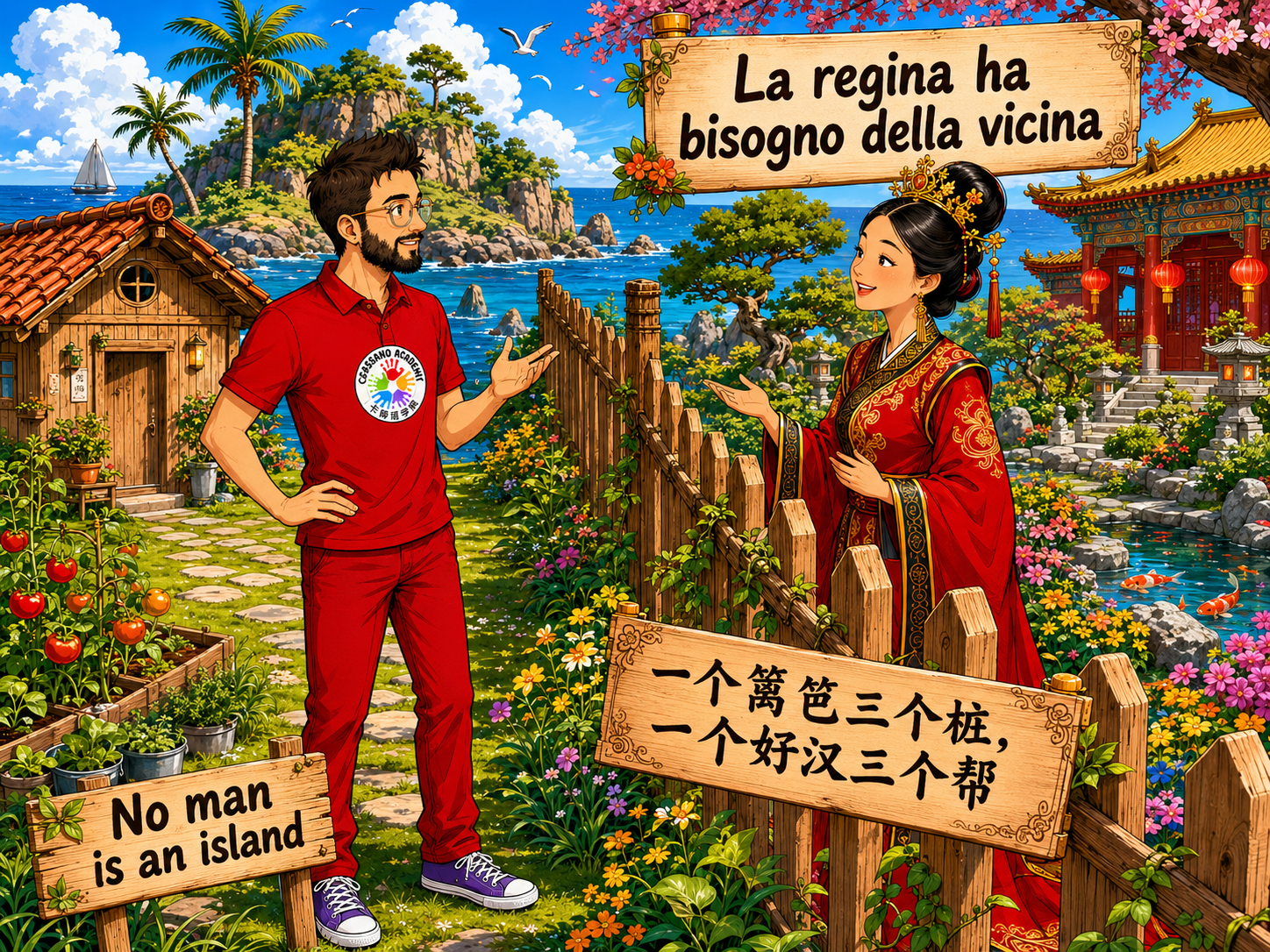
Have you ever wondered what the real engine driving us to learn a new language actually is? We often focus too much on grammar rules, vocabulary lists, and smartphone apps, forgetting the very essence of communication. There is an ancient and wise Italian proverb that encapsulates a profound truth, not just for daily life, but also for our journey into language learning: "Anche la regina ha bisogno della vicina" (Even the queen needs her neighbor).
This saying reminds us that no one, no matter how high up they are, can survive entirely on their own. But what does a queen (or a next-door neighbor) have to do with studying English, French, German, or Mandarin Chinese? Let’s find out together.
Humans are made for cooperation
The core concept is simple yet powerful: we were not designed to be soloists, but rather to collaborate and weave meaningful relationships.
Today, we constantly hear about "VIPs", influencers, or successful public figures who appear completely self-sufficient, surrounded by an aura of total independence. Reality, however, is quite different. Even those who have reached the highest peaks have a desperate need for people with whom to share not only what they own, but above all, what they do and who they are. True wealth does not lie in the isolation of one's own castle, but in the quality of the connections we forge with others.
Sharing and vulnerability – such as the fear of making mistakes when speaking a new language – are the fundamental building blocks through which we construct our identity and personal growth.
What does this have to do with learning foreign languages?
If you think about it, the connection is immediate. What is the ultimate goal when we decide to study a foreign language? It certainly isn't to recite a monologue in front of the mirror or to score well on a written test just for the sake of it.
We learn a language for one major reason: to communicate with our neighbor.
In an increasingly interconnected world, the concept of a "neighbor" has expanded. Today, your neighbor might be a colleague in London, a supplier in Beijing, or a passerby asking for directions in your hometown. Learning languages means tearing down the walls of your own castle (just like an enlightened queen would do) to step out onto the street and shake hands with those who speak a different tongue.
Language acquisition is not an individual, theory-based path; it is a social, practical, and interactive act. We need others to practice, to listen, to make mistakes, and, through those mistakes, to constantly improve.
Equivalents in English and Chinese
The beauty of linguistics lies in the fact that the need for cooperation is a universal trait of the human mind, reflected in cultures all over the world. This is how English and Mandarin Chinese express the same exact concept as our Italian proverb:
1. "No man is an island"
In the Anglo-Saxon world, this concept is masterfully captured by the famous line from poet John Donne: "No man is an island". No one can live entirely cut off from the rest of the human continent. To communicate in English, you must step off your "island" and embrace interaction, exchange, and cooperation with both native and non-native speakers.
2. 一个篱笆三个桩,一个好汉三个帮
In China, a millenary culture expresses this cooperation through a beautiful traditional saying:
-
Characters: 一个篱笆三个桩,一个好汉三个帮
-
Pinyin: Yī gè líba sān gè zhuāng, yī gè hǎohàn sān gè bāng.
-
Literal Translation: "A fence needs three stakes to stand upright; a man of value needs three people to help him."
Just as a fence cannot stand on its own and a queen needs her neighbor, even the most talented language learner needs a community, a learning partner, and an engaging environment to make their skills truly flourish.
Get Involved with Cassano Academy
If you truly want to learn how to communicate and stop being a "soloist" of grammar rules, there is only one way: practice together. At our academy, we firmly believe that languages are learned by doing, speaking, and collaborating, turning every lesson into a moment of authentic connection. Don't stay isolated in your castle: come and meet your new traveling companions!
FAQ: Even the Queen needs her neighbor
It means that nobody is entirely self-sufficient. Even the richest, most powerful, or highly successful people (the "queens" or "VIPs") have a fundamental need to cooperate, interact, and share their lives and activities with others (their "neighbors").
It applies because language is a tool for social communication, not a solitary exercise. We do not learn a language to isolate ourselves, but to connect with our global "neighbors". To develop true fluency, it is indispensable to interact, collaborate, and actively practice with other people.
Yes. In English, the concept of social interdependence is expressed by the famous saying "No man is an island". In Mandarin Chinese, the expression used is 一个篱笆三个桩,一个好汉三个帮 (A fence needs three stakes, a man of value needs three helpers), which highlights how success and stability always stem from collaboration.