

Why forcing language learning is harmful
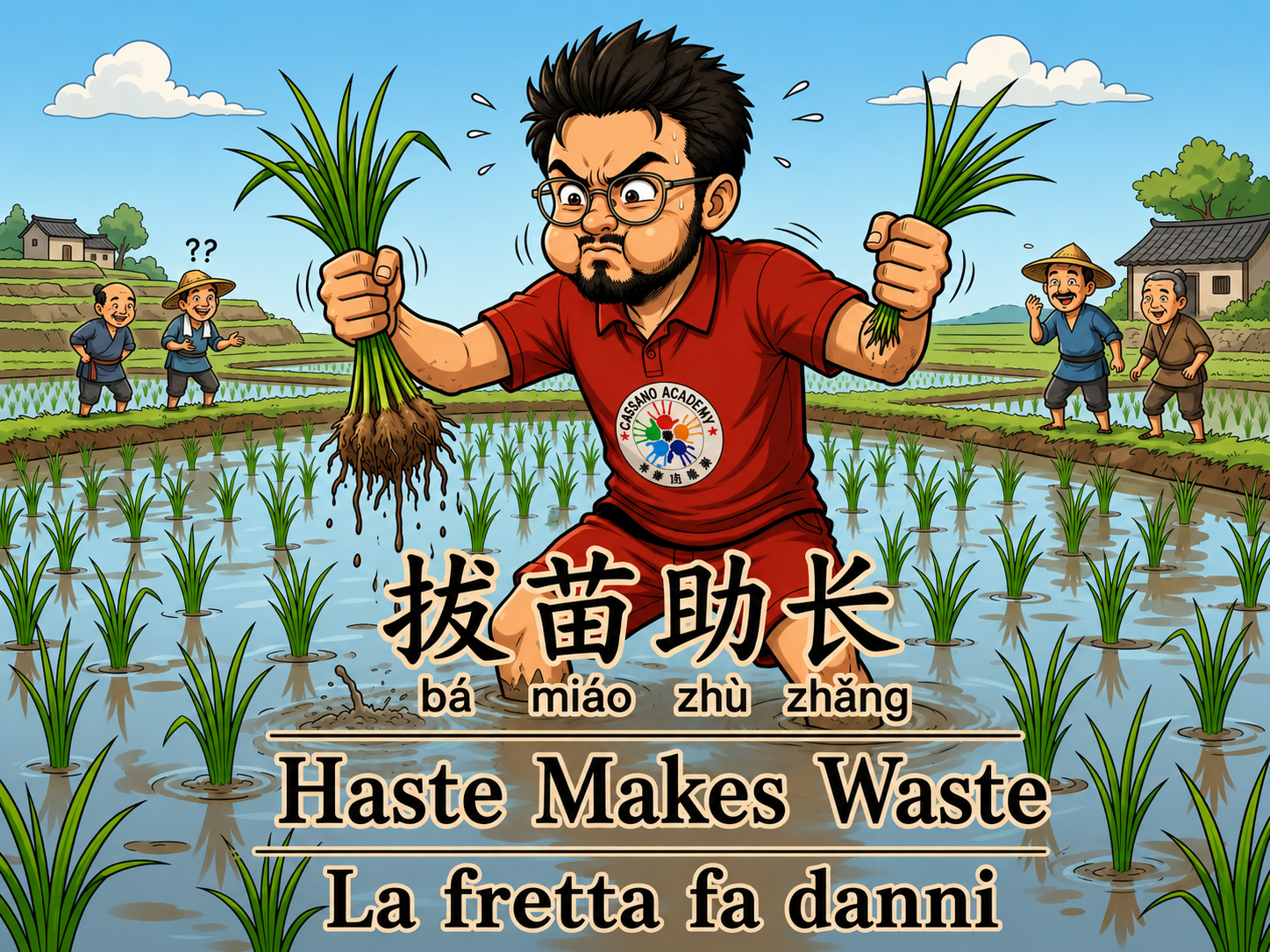
In Chinese, they say 拔苗助长 (bá miáo zhù zhǎng), which literally means 'pulling up sprouts to help them grow' or 'the grass doesn't grow any faster if you pull it.' In Italy, we say that 'the hurried cat gives birth to blind kittens,' while in the Anglo-Saxon world, they remind us that 'haste makes waste,' meaning that rushing causes damage. It is fascinating to notice how the same truth exists in every culture: haste does not build up; instead, it destroys.
The story behind the proverb
Once upon a time, there was a farmer who, impatient to see his rice crops grow, decided to spend the day in the fields pulling every single sprout upward just a little bit. He returned home exhausted but proud, telling his family, "Today, I helped the plants grow!" The next day, his son rushed to the field only to find all the plants dead, because their roots had been torn from the soil.
In the context of language learning, forcing the stages of acquisition produces the exact same result: it strips away the student's roots, leading to frustration and ultimate abandonment.
Respecting learning pacing
Every person has its own rhythm of assimilation. When studying a foreign language, moving information from short-term to long-term memory requires time, sleep, and spaced repetition.
Pushing a student toward advanced grammatical structures (such as B2 or C1 levels) before their core foundations (A1/A2) are deeply rooted creates a cognitive overload. You are not accelerating the process; you are destabilizing the roots.
The teacher's role: Adapting, not forcing
An excellent educator is not one who rigidly adheres to a fixed syllabus or a textbook index, but one who acts as an experienced farmer. A language teacher should:
- Listen to specific needs: Recognize whether a learner requires more time for phonetics or syntax.
- Calibrate comprehensible input: Provide what linguist Stephen Krashen defined as "Input + 1"—a level of difficulty just slightly above their current competence, ensuring it is stimulating but never frustrating.
- Create a safe environment: Performance anxiety triggers the brain's affective filter, completely blocking language acquisition.
Cultivating flexibility
Learning a language is not a sprint; it is a profound journey of personal transformation. Just like the sprouts in the ancient proverb, our minds need water, sunlight, and above all, time.
If you are a student, respect your own pace. If you are a teacher, adapt your guidance to the unique mental architecture of the person sitting in front of you. Only then will knowledge develop deep, lasting roots.
FAQ: Haste Makes Waste
Rushing the process (the Bá Miáo Zhù Zhǎng effect) prevents the proper integration of grammar structures and vocabulary. This leads to the creation of "fossilized errors" (repeated mistakes that become deeply ingrained and hard to correct) and high rates of student frustration.
Through continuous formative assessment, active observation, and constant feedback loops. A personalized learning path dynamically adapts to the learner's emotional and cognitive responses during each study session.
Yes. The key is efficiency, not speed. Techniques like Spaced Repetition, passive language immersion, and short, daily practice sessions (15–20 minutes) optimize neuroplasticity without overloading the mind.