

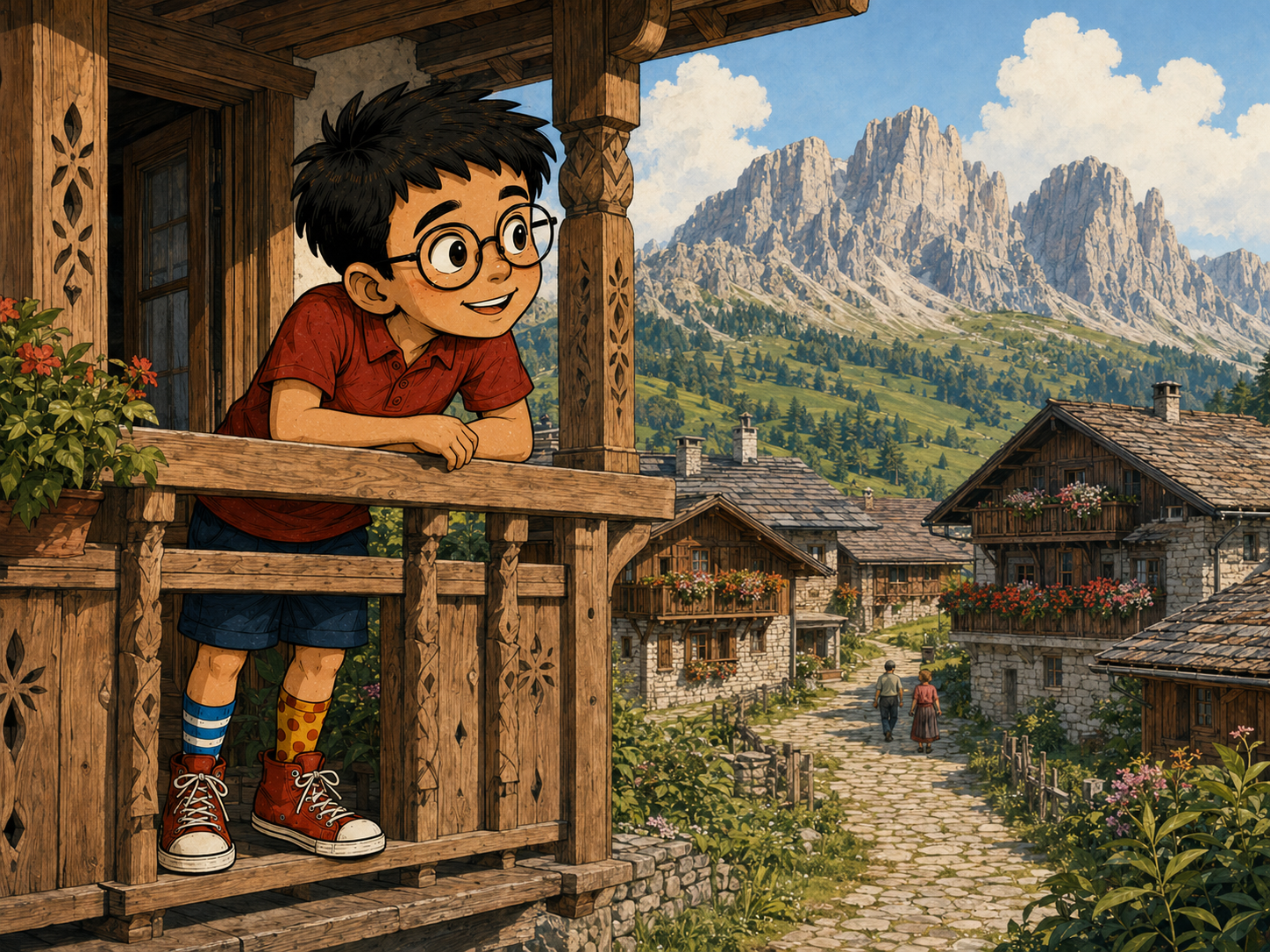
Have you ever imagined climbing a mountain and meeting a language that sounds a little Italian, a little French and, every now and then, even German?
This is not a language game invented by Marco after eating too many dumplings. It is Ladin, an ancient and living language spoken in the heart of the Dolomites.
Here is the first surprise: Ladin is not simply “an Italian mountain dialect”. It is a Romance language, born from spoken Latin just like Italian, French, Spanish, Portuguese and Romanian. Think of them as members of the same large family: they resemble one another, but each has its own history and voice.
What is Ladin?
The word ladin comes from Latin LATINUS, meaning “Latin”. Dolomite Ladin developed from the everyday Latin spoken in the Alpine regions. Over time, it mixed with elements that predated Roman rule and with influences from neighbouring languages.
This is why some words may remind an English-speaking learner of familiar Romance words, while others are surprising:
| Val Badia Ladin | English |
|---|---|
| Bun dé | Good morning |
| Buna sëra | Good evening |
| Buna nöt | Good night |
| A ciasa | Home / to the house |
| Aiüt | Help |
English is a Germanic language, not a Romance language, yet much of its vocabulary came from French and Latin. Words such as evening or home do not resemble the Ladin forms, but English speakers may recognise distant relatives through French or Italian. Ladin therefore offers a curious bridge between familiar Latin-based vocabulary and a distinctly Alpine sound.
Where is it spoken?
Dolomite Ladin is spoken mainly in valleys arranged around the Sella massif, across South Tyrol, Trentino and Veneto:
-
Val Badia;
-
Val Gardena;
-
Val di Fassa;
-
Livinallongo del Col di Lana and Colle Santa Lucia;
-
Cortina d’Ampezzo.
The language is divided not only by mountains but also among three provinces: Bolzano, Trento and Belluno. Treccani estimates that there are about 30,000 speakers of Dolomite Ladin.
There is a small geographical and linguistic trap to avoid: Dolomite Ladin is related to Romansh, spoken in the Swiss canton of Graubünden, and to Friulian, but these are not simply three names for the same everyday language. They are distinct linguistic realities within the broader Rhaeto-Romance area.
Is there only one kind of Ladin?
No, and that is one of its most fascinating features. Each valley has developed its own variety:
-
Badiot in Val Badia, with further local varieties;
-
Gherdëina Ladin in Val Gardena;
-
Fascian, including the cazet, brach and moenat varieties;
-
Fodom in Livinallongo and Colle Santa Lucia;
-
Ampezan in Cortina d’Ampezzo.
These varieties share many features, but they are not identical. Even “thank you” may appear as dilan, giulan or iolan, depending on the area.
It is rather like arriving at a family reunion: everyone is related, but each person tells the story in a different accent.
A common written standard called Ladin Dolomitan has also been developed. Local varieties, however, remain more deeply rooted in community life, and the common standard has not become the general administrative language of all the valleys.
When was Ladin born?
We cannot circle one date on a calendar and write, “Ladin was born today.” Languages do not appear overnight; they change slowly from one generation to the next.
A decisive moment came in 15 BC, when the Alpine regions were annexed to the Roman Empire. Local populations gradually adopted the Vulgar Latin spoken by soldiers, officials and merchants, without completely erasing the languages and words already present in the area.
After the fall of the Roman Empire, Alpine Latin continued to change and came into contact with Germanic, northern Italian and, farther east, Slavic languages. Over the centuries, the former linguistic area shrank into a series of separated “islands”.
For a long time, Ladin was mainly an oral language. The earliest known evidence of its public written use dates from 1631. The first grammar of the Val Gardena variety was published in 1864, and the first book written entirely in Ladin appeared in 1878.
Ladin was not born in the nineteenth century: that was when it began to enter books more forcefully.
Ladin and English: distant relatives through history
Ladin and English do not belong to the same immediate branch of the Indo-European family. Ladin is Romance, whereas English is Germanic. Their basic grammar and oldest everyday vocabulary therefore developed along different paths.
However, English absorbed an enormous amount of French and Latin vocabulary. An English speaker may consequently recognise the Latin family resemblance indirectly. Ladin aiüt recalls Italian aiuto and French aide, while English has the related word aid. This does not make the languages mutually understandable, but it creates occasional moments of recognition.
Ladin also preserves ancient Alpine words such as crëp, “rock”; roa, “scree or gravel landslide”; and dascia, “fir branch”. It has its own sounds and grammatical forms, while contact with Tyrolean German produced numerous loanwords, especially for crafts and material life. In Fascian, for example, tisler means “carpenter” and slosser means “locksmith”.
The result is a Romance language that has spent centuries among mountains and multilingual communities, filling its backpack with words collected along the way.
A small Ladin survival kit
The following forms belong particularly to the Val Badia variety. Other valleys may use different spellings or words.
| English | Val Badia Ladin |
| Good morning | Bun dé |
| How are things? | Co vara pa? |
| Thank you | Giulan |
| Please | Prëitanbel |
| Goodbye | A s’udëi |
| What is your name? | Co aste pa inom? |
| Where are you going? | Ula vaste pa? |
| Home | A ciasa |
| Help! | Aiüt! |
| Unbelievable! | Nia da crëi! |
After an overly ambitious mountain walk, the most useful expression is probably Aiüt! In front of the view, however, Nia da crëi!—literally “not to be believed”—may be perfect.
A curious little particle
Questions such as Co vara pa? (“How are things?”) contain the particle pa. It should not be translated word by word. It helps make the question sound natural and conversational.
English also has small elements whose job is more pragmatic than literal: compare the friendly difference between “How are you?” and “So, how are you doing?” Languages often use tiny words to shape tone rather than add a separate piece of information.
The Dolomites also speak through legends
Ladin culture preserves a rich heritage of folk stories. Tales from Val di Fassa introduce the vivènes, female figures connected with water and woods; the salvans, wild beings of the mountains; and the bregostènes, mysterious and often unsettling creatures.
There is also the famous Kingdom of the Fanes, a great legendary narrative connected with the Dolomites. Language, landscape and memory are woven together: the mountains are not merely the background to the stories but seem to become characters themselves.
A world of nicknames
Nicknames have often played an important role in Ladin communities. They could identify a family’s place of origin, a personal characteristic, an occupation or a memorable event.
In small villages where many people shared the same surname, a nickname worked almost like a human GPS. It did not provide coordinates, but it helped everyone understand immediately who was being discussed.
A small language can be very modern
Ladin does not live only in proverbs, fairy tales or museums. It is used at home, at school, in the media, in music, in local administration and online. Val Gardena and Val Badia also have a distinctive multilingual school system in which Ladin, Italian and German coexist.
Being a minority language does not mean belonging to the past. It means facing a very modern challenge every day: finding words for the internet, technology, education and daily life without losing one’s identity.
Marco’s challenge
Try saying these three expressions:
-
Bun dé! — Good morning!
-
Co vara pa? — How are things?
-
Giulan! — Thank you!
Now imagine using them in a Dolomite valley. Even if your pronunciation is not perfect, you will have done the most important thing: approached another language with curiosity and respect.
And if somebody answers too quickly? Do not panic. Look at the mountains, smile and say: Nia da crëi!
Anyway...
Ladin reminds us that a language should not be measured only by the number of people who speak it. Around thirty thousand voices can carry two thousand years of history, different local varieties, ancient Alpine words, German loans, fantastic stories and new digital messages.
It is not Italian spoken at high altitude, nor is it Latin frozen in the snow. It is a complete, changing and living language: one of the most precious voices of the Dolomites.
Which Ladin word would you put in your backpack first?
FAQ
Ladin is a recognised and protected minority Romance language. It includes several local varieties, such as Badiot, Gherdëina Ladin, Fascian, Fodom and Ampezan.
Dolomite Ladin is spoken mainly in Val Badia, Val Gardena, Val di Fassa, Livinallongo del Col di Lana, Colle Santa Lucia and Cortina d’Ampezzo, across the provinces of Bolzano, Trento and Belluno in northern Italy.
No. Ladin and Italian both developed from Vulgar Latin. They are sister languages; Ladin is not a form of Italian that changed over time.