


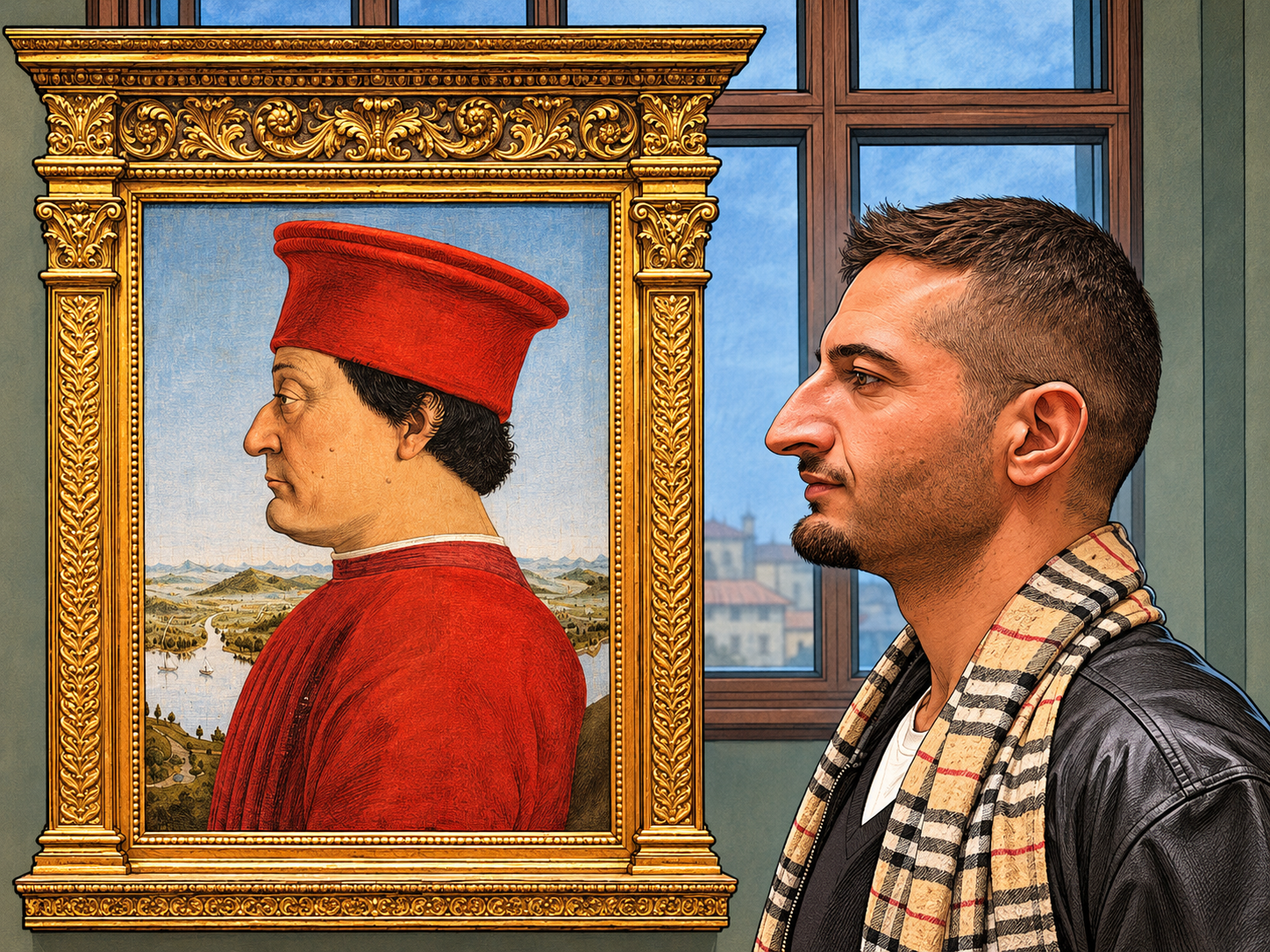
Same nose. Same story?
Standing beside the portrait of the Duke of Urbino, I turn sideways. I look at him, then look at the photograph again.
Different hat. Different clothes. The nose, however, might give us something to discuss.
For a few seconds, the comparison seems to tell the whole story: two profiles, a resemblance and a photograph worth keeping. But is that one detail enough to know the two people?
Of course not. Yet when we read in a foreign language, we sometimes do exactly that: we recognise something and immediately decide that we understand the rest.
Last week, in “Can You Read It?”, we learned not to stop at every unfamiliar word. This week, we take another step: let’s not stop at our first interpretation either.
A familiar-looking word can mislead us
Imagine reading this sentence in a museum description:
“The portrait is in the library.”
An Italian learner may recognise portrait, then confidently connect library with the Italian word libreria.
And off they go, looking for a bookshop.
But library means biblioteca in Italian. A shop that sells books is a bookshop or a bookstore.
The resemblance suggested a meaning. It did not guarantee it.
These are known as false friends: words in different languages that look or sound similar but have different meanings.
Actually can cause a similar problem. It usually means in realtà, rather than the Italian attualmente, which means “currently”.
“Actually, this is a copy.”
In other words:
“In fact, this is a copy.”
That opening word invites us to correct an impression. If we misunderstand it, we may miss the correction itself.
Knowing the words is not always enough
Not every misunderstanding comes from vocabulary. Sometimes we know the words but overlook the connections between them.
Read this:
“Marco wanted to take another photo, but the museum was closing.”
Marco wanted another photograph, but the museum was closing.
The word but changes the direction of the sentence: it introduces an obstacle to his wish.
And notice something else: the text does not tell us whether Marco managed to take the photograph. We can imagine an ending, but we should distinguish it from what we actually read.
Other useful words include:
-
because, which introduces a reason;
-
although, which signals a contrast;
-
instead, which introduces an alternative.
They are small, but they help us follow the reasoning. Looking only at nouns and verbs may cause us to miss how the information fits together.
Does the text say it, or am I imagining it?
Back to the museum:
“Marco stood beside the portrait. His friend smiled and took a photo.”
What do we know?
Marco stood beside the portrait. His friend smiled and took a photograph.
What might we infer?
Perhaps the friend noticed a resemblance. Perhaps Marco made a joke. Perhaps they were simply enjoying their day.
All are possible interpretations. None is confirmed by those two sentences.
Careful reading means distinguishing what a text states, what it suggests and what we add ourselves.
We do not need to stop making guesses: they help us understand. We need to be willing to revise them when new clues appear.
Read again with a different question
On the first reading, ask:
“What is this text about?”
On the second, ask:
“Which words support my interpretation?”
This gives rereading a clear purpose. We look for a negative, a reason, a contrast or a reference to a particular person or time.
If something does not fit, we can check a word in a dictionary, read the next sentence or reconsider our first idea.
Even a label beside a painting can change what we thought we recognised. The title, the person’s name and a short explanation provide information that a face alone cannot tell us.
A little reading practice
Try this short text:
“At first, Marco thought the painting was an original. Then he read the label: ‘Copy after a fifteenth-century portrait.’ Although he was surprised, he stayed to look at it.”
Before translating every word, find three pieces of information:
-
What did Marco think at first?
-
What information changes his mind?
-
What does he do afterwards?
At first, he thinks the painting is an original. The label identifies it as a copy based on a fifteenth-century portrait. Despite his surprise, Marco stays to look at it.
Here, after does not simply mean “later in time”: in the label, it indicates that the copy is based on an earlier work. Context helps us choose the appropriate meaning.
And although stops us from jumping to a conclusion: Marco is surprised, but he does not leave.
The Cassano Academy challenge
This week, choose a short description, message or label in the language you are learning.
After your first reading, write one sentence explaining what you think you understood. Then read again and find:
-
a word that connects two pieces of information;
-
a detail that confirms or corrects your interpretation;
-
something you imagined that the text does not actually say.
Finally, rewrite your summary.
The aim is not to find a mistake at all costs. It is to learn to support your interpretation.
As for the duke and me, the photograph does confirm a certain resemblance in profile.
For the noble title, however, I will need more evidence.
FAQ
Read it once to identify the main topic. Then look for the information you need and use nearby sentences to interpret unfamiliar words. Check a dictionary when a word is essential to understanding the meaning.
False friends are words in different languages that look or sound similar but have different meanings. For example, the English word library means biblioteca in Italian, not libreria. Likewise, actually means in realtà, not attualmente. Context helps you recognise these differences.
Ask yourself which words support your interpretation. If a text says that someone smiles, the smile is a fact; the reason may not be stated. Separate explicit information from assumptions and revise your interpretation when new details emerge.